


If you’ve ever looked at commercial office rents in Delhi, you know the feeling: the city looks amazing on paper… until you see the actual numbers.
Founders and small teams end up in a strange dilemma:
-
You’d love a Delhi address on your letterhead, GST certificate, and company documents.
-
But you don’t really need a full office in Connaught Place or South Delhi yet.
-
And working from home or a shared flat doesn’t exactly scream “professional,” especially when you’re dealing with clients, vendors, or investors.
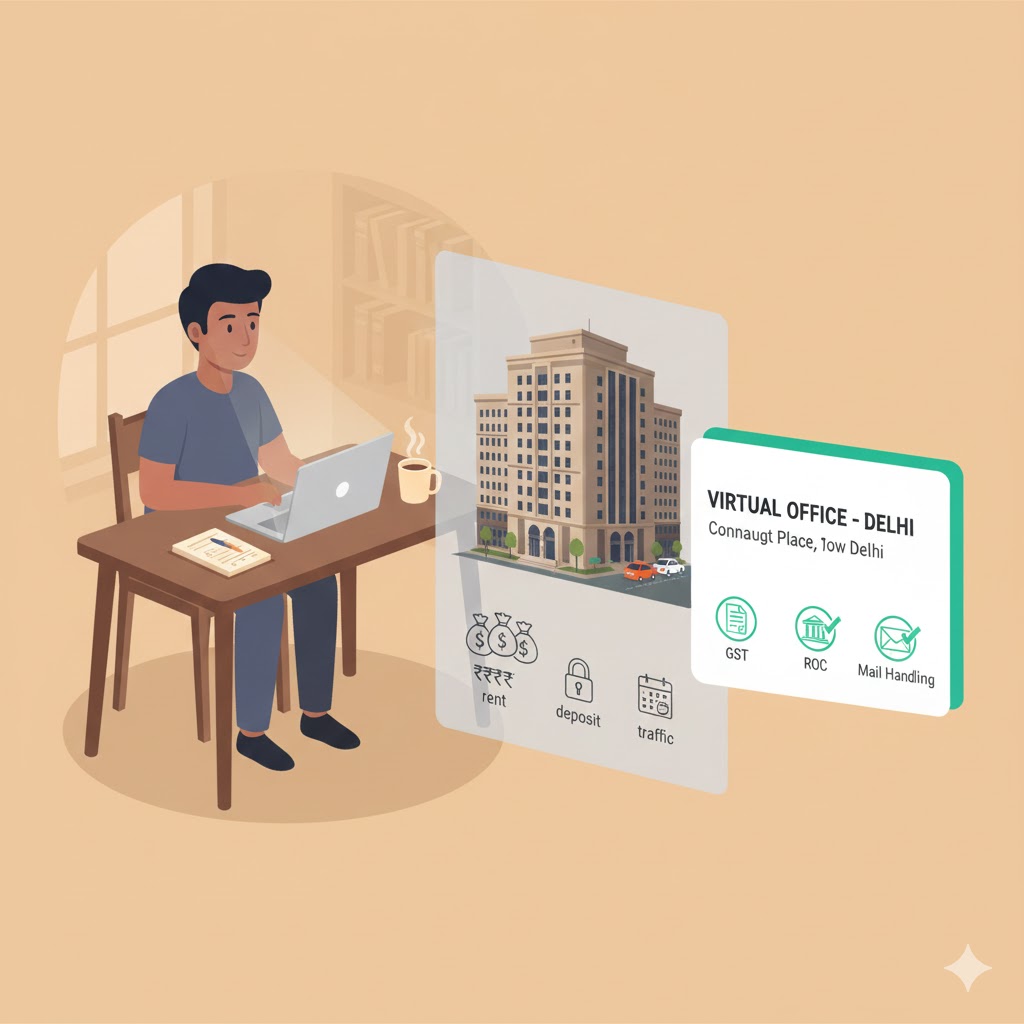
That’s where a virtual office in Delhi becomes interesting. It gives you the right to use a real, recognised business address in the city – plus documentation that works for GST registration and company registration (MCA/ROC) – without signing up for a long, expensive lease.
In this guide, we’ll walk through Delhi specifically:
-
Why a Delhi virtual office makes sense for GST and ROC
-
What documents you actually need in Delhi
-
How to choose the right area and plan inside the city
-
A simple, real-world flow of getting a virtual office in Delhi with Xporate
-
Common questions and red flags to watch out for
Think of this as the blog you wish someone had written before you started asking CAs, friends and WhatsApp groups what to do.
Why a Virtual Office in Delhi Makes Sense for GST & Company Registration
Delhi still matters as an address
There’s no way around it: “New Delhi” still carries weight.
When a client sees a Delhi address on your website or invoice, they instantly file you under “serious business” rather than “side project”. The same goes for investors, vendors and people who don’t know you yet but have to decide whether to trust you with their money or data.
Add to that:
-
Delhi is home to central ministries and regulators.
-
Many established companies, service firms and agencies already maintain a presence here.
-
Areas like Connaught Place, Green Park, Saket, and Laxmi Nagar are known business zones, not just random pin codes.
So even if your team is spread across NCR or other cities, a Delhi address can be a strategic asset.
The problem with a traditional Delhi office
The flip side is obvious to anyone who has tried to lease an office:
-
Prime commercial areas are expensive.
-
Landlords expect deposits, fit-out, and long lock-ins.
-
You’re responsible for utilities, maintenance, and making sure the space is actually used.
-
And of course, there’s Delhi traffic. Commuting across town every day just to “own” an address quickly loses its charm.
For a lot of modern businesses – SaaS, agencies, consultants, small service firms, e-commerce sellers – this is just not worth it. You don’t need a full office with 10–20 seats; you need a reliable, compliant address and flexible access.
How a virtual office changes the equation
A virtual office in Delhi is a simple idea:
-
You get the right to use a real Delhi business address at a coworking or business centre.
-
The provider gives you a documentation pack that works for MCA/ROC and GST.
-
They handle mail and courier on your behalf.
-
And if you ever need to meet someone in person, you can book meeting rooms at the same centre instead of renting it full time.
With Xporate, for example, Delhi virtual office plans are built around that exact use case – giving you a GST- and ROC-ready address in specific Delhi locations, without the costs and friction of a dedicated office from day one.
Is a Virtual Office in Delhi Valid for GST Registration?
Let’s start with the question everyone asks their CA first.
The short, honest answer
Yes, you can use a virtual office in Delhi for GST registration.
There’s nothing magical about the word “virtual”. What matters to GST authorities is:
-
Is the address real, commercial premises?
-
Do you have a proper right to use it, shown through agreements and NOCs?
-
Do your GST filings and documents match that address consistently?
If those boxes are ticked, the fact that you don’t have 10 full-time employees sitting there all day is not the issue.
What GST officers expect to see for a Delhi address
For a Delhi virtual office used for GST, you’ll almost always deal with two buckets of documents:
From the premises side (your provider):
-
A service or rent agreement that clearly mentions the premises and your right to use it.
-
A No Objection Certificate (NOC) from the owner or authorised entity.
-
A recent utility bill or equivalent proof of the property.
From your business side:
-
PAN of the entity or proprietor.
-
Aadhaar + PAN of the authorised signatory.
-
Incorporation certificate and MoA/AoA or LLP agreement (if you’ve already incorporated).
-
Board resolution / authorisation letter where applicable.
-
Bank proof (cancelled cheque, statement, etc.).
Your CA or GST practitioner will build your application around these, but the starting point is always a clean documentation pack from the virtual office provider.
Common ways Delhi GST applications go wrong
Most horror stories you hear are not about “virtual office vs real office”. They’re about avoidable mistakes like:
-
The address written one way in the agreement and another way in the GST form.
-
Old or incomplete utility bills that don’t match other documents.
-
No clarity on signage or on-site verification, so officers get confused at inspection.
-
KYC gaps for promoters or directors.
A provider that does this daily in Delhi will usually have a ready checklist and a process to avoid these trips and falls. This is where working with a structured operator like Xporate helps: they’ve already seen what Delhi officers typically ask for, and build the product around those expectations.
Using a Virtual Office in Delhi for Company Registration (MCA/ROC)
GST is only half the story. If you’re incorporating a company, you also need a registered office. That can absolutely be a virtual office – as long as it’s set up correctly.
What a “registered office” really means in practice
For MCA/ROC purposes, your registered office in Delhi is:
-
The address where official notices and communication can be sent.
-
A location that you have a documented right to use.
-
A place that can, in principle, be visited or verified.
It does not have to be a big private office with your logo on the glass door and 20 employees inside. It just has to be a real location where notices reach you and where your presence can be justified.
How a Delhi virtual office becomes your registered office
When you sign up for a company-registration-ready virtual office in Delhi, you should get:
-
A formal agreement that clearly states your usage of the address as a registered office.
-
An NOC from the owner or space operator.
-
Supporting documents like utility bills for the property.
Your CS or CA then uses this bundle as address proof during incorporation. The ROC sees a real Delhi address backed by paperwork, not just a random flat someone typed in.
Typical doubts founders have around ROC in Delhi
A few questions come up over and over:
Can I change my registered office later?
Yes. You can move from one Delhi location to another, or even to another state, by following the standard ROC procedure. Many companies start with a virtual office, and once they hit a certain team size, move into a dedicated physical office later.
Do I have to keep all physical records at the virtual office?
In practice, a lot of companies maintain records digitally or in a single central location. The registered office is primarily about official communication and legal identity, but your CA/CS can advise on record-keeping formalities for your type of company.
What if ROC or another authority sends a notice?
That’s where a proper virtual office plan matters. With Xporate, for example, staff at the centre receive mail on your behalf and follow a standard notification process so you actually see important documents on time, instead of them sitting in a pile somewhere.
Types of Virtual Office Plans in Delhi (and How to Choose)
Not all “virtual offices” in Delhi are meant for the same thing. Picking the right plan saves you time, money, and a lot of back-and-forth with your CA.
1. Business address-only plans
These are the simplest:
-
You get a Delhi business address.
-
You can use it on your website, cards, signatures, and marketing.
-
The centre handles basic mail and courier.
This is useful if you don’t need GST or company registration in Delhi yet, but you want to present a Delhi-based front.
2. Virtual office in Delhi for GST registration
These plans are built with GST in mind. They’re ideal if:
-
You already have a registered company elsewhere and want Delhi GST or APOB.
-
You run a service business and want to bill from Delhi.
-
You’re an e-commerce seller who needs a Delhi registration without opening a warehouse.
Here you want the provider to be very explicit about:
-
GST support for the plan.
-
Documentation tailored for GST.
-
Experience dealing with Delhi GST officers and inspections.
3. Virtual office in Delhi for company registration
This is usually for new founders who want to incorporate in Delhi from day one.
The focus here is on:
-
Clear ROC-friendly documentation.
-
Comfortable use as registered office.
-
Ability to continue using the same address for GST later, if needed.
4. Combined GST + company registration + APOB plans
For some businesses, especially those planning a bigger footprint, it’s cleaner to set everything up together:
-
Incorporation in Delhi.
-
GST registration in Delhi.
-
Plans for future APOB registrations, if you’ll operate in more than one place.
Xporate structures its Delhi plans so you can pick exactly what you need right now – business address, GST support, ROC support – and not overpay for things you’ll only use years later. The key is to be honest about where your business is headed over the next 12–18 months and pick a sensible starting point.
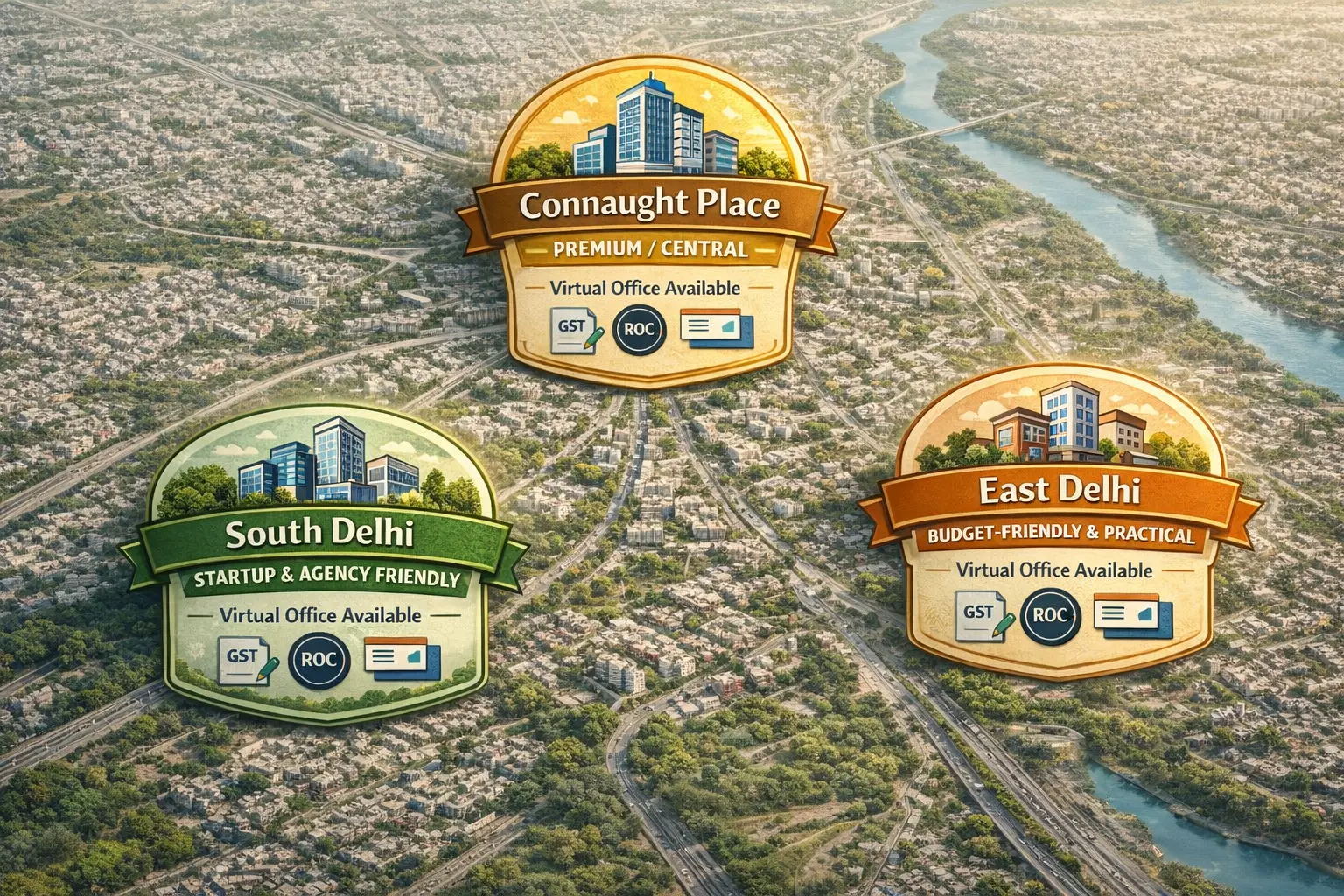
Best Areas in Delhi for a Virtual Office (and How to Think About Them)
Even once you’ve decided on Delhi, you still have to pick where in Delhi.
There’s no single right answer, but here’s a simple way to think about it.
Connaught Place (CP): central and prestigious
If you close your eyes and picture “a Delhi office”, chances are you think of Connaught Place.
-
CP is central, well-known, and packed with businesses and government offices.
-
A CP address can impress clients who care about prestige and centrality.
-
The trade-off is usually higher pricing compared to other parts of the city.
If your brand is positioned as premium, corporate, or advisory in nature, CP can be worth the extra spend.
South Delhi clusters: Green Park, Saket, and nearby hubs
South Delhi areas strike a different balance:
-
Still very reputable and familiar to clients.
-
Often preferred by tech companies, agencies, consultants and new-age service firms.
-
Easier to access if you or your team live in South or West Delhi.
Xporate has virtual office options in this belt, giving you the combination of a “good address” without going all the way to CP prices.
East Delhi: Laxmi Nagar and surrounding commercial pockets
East Delhi doesn’t always get the spotlight, but:
-
It’s a smart choice if you’re cost-conscious and based on that side of the city or in nearby NCR.
-
It can be more convenient for founders commuting from Ghaziabad side or East Delhi suburbs.
-
Certain client segments may actually prefer a location closer to where they are.
A Laxmi Nagar or similar East Delhi address can give you “New Delhi” on paper with a more relaxed budget.
The bigger point: don’t pick an area just because it sounds fancy. Think about your clients, your team, and your actual commute. The right area is one that feels believable and convenient for the type of work you do.
Step-by-Step: Getting a Virtual Office in Delhi with Xporate
Let’s put this together into a simple, linear flow. Here’s what it typically looks like in real life.
Step 1 – Clarify your use case
Before you talk to anyone, answer a few questions for yourself:
-
Do you need Delhi for GST, company registration, or both?
-
Are you planning to stay focused on Delhi, or is this step one in a multi-city presence?
-
Do you expect to move into a physical office later, or stay virtual for the next few years?
When you speak to a Xporate advisor, sharing this upfront helps them tell you which plan makes sense and which one you don’t need yet.
Step 2 – Choose your Delhi location and plan
Next, pick your combination of:
-
Neighbourhood – CP, South Delhi, East Delhi, etc.
-
Plan type – business address only; GST-focused; company registration; or a combo.
Here’s a simple rule of thumb:
-
If your operating team and clients are mostly in one part of Delhi/NCR, choose a location that matches that story.
-
If your work is fully remote and pan-India, prioritise perception and budget (for example, Green Park or Saket can be a sweet spot).
Step 3 – Complete KYC and virtual office signup
Once you’ve picked a plan:
-
Xporate shares their KYC and documentation checklist.
-
You submit the required entity and promoter documents.
-
Any questions about your use case (GST, ROC, APOB) are clarified at this stage.
This is where you want to make sure you understand exactly which documents you’ll get back and how they’ll be worded.
Step 4 – Receive your Delhi documentation pack
After approval, you receive:
-
Your agreement for the Delhi address.
-
The NOC for the premises.
-
Utility bill / property proof.
-
Any other promised proofs or supporting documents.
You’ll share these with your CA/CS or GST practitioner, who plugs them into your filings.
Step 5 – File for GST and/or company registration
Now the compliance side kicks in:
-
Your professional advisor uses the Delhi address and documents in your MCA forms and/or GST application.
-
You address any follow-up questions from officers, often with help from your advisor and provider.
-
If a document needs a correction (for example, a spelling adjustment), your provider can typically reissue it.
The timestamps and final approval depend on the government side, but from your side, the paperwork is already in place.
Step 6 – Start using your Delhi virtual office
Once you’re live:
-
Use the Delhi address on invoices, letterheads, your website, GST portal and MCA records.
-
Make sure you understand how mail handling works – when and how Xporate notifies you, and whether you prefer pickup or forwarding.
-
If your plan includes meeting room credits, actually use them – client meetings in a nice Delhi workspace can be a very different experience from a coffee shop.
At this point, the virtual office is just part of your infrastructure, like your domain name or bank account – quietly supporting your business in the background.
Pricing & Inclusions – What to Expect in Delhi
Every provider prices things a bit differently, but there are some patterns you’ll see across the market.
What the pricing usually reflects
The cost of a virtual office in Delhi tends to vary based on:
-
The area and building (CP vs East Delhi vs South Delhi).
-
Whether the plan includes GST support, company registration support, or both.
-
Extras like meeting room credits, add-on workspace access, and mail forwarding.
Entry-level business-address options will typically sit at the lowest range. When you add GST, ROC, or premium locations, pricing moves up.
Typical inclusions you should insist on
A serious Delhi virtual office plan should include at least:
-
The right to use the business address in a specified centre.
-
A clear documentation pack for GST and/or company registration.
-
Defined mail and courier handling process.
-
Clarity on whether you can use the address publicly (website, cards, etc.).
-
The option to use meeting rooms or coworking desks, even if that’s an add-on.
Xporate wraps all of this into clearly named Delhi virtual office plans, so you always know what you’re paying for – and what you aren’t.
Red flags to watch out for in Delhi
Some warning signs to take seriously:
-
The provider doesn’t clearly mention documentation anywhere.
-
They use or suggest residential addresses as “offices” without context.
-
They dodge questions about GST and ROC suitability with vague answers.
-
They can’t show sample docs (with sensitive info hidden) when asked.
-
The offer feels too cheap and too casual for something that touches your legal identity.
If you’re trusting an address with your company registration and GST, you want a partner that treats compliance as a feature, not as an afterthought.
Who a Delhi Virtual Office Is Really For (3 Common Stories)
Sometimes the easiest way to know if this is for you is to see who else it helps.
1. The Delhi founder who doesn’t want to rent a full office yet
You live in Delhi, you know the city, but you’re happy working from home or a laptop-friendly cafe. At the same time:
-
You want to incorporate your company.
-
You need GST registration.
-
You don’t want to put your home address everywhere.
A Delhi virtual office lets you build a professional, compliant presence in the city while your actual day-to-day remains as flexible as you like.
2. The out-of-state founder who wants a Delhi footprint
Your team sits in another city – maybe Jaipur, Chandigarh, Lucknow or Coimbatore – but:
-
Your clients are in NCR.
-
You pitch to companies that are more comfortable seeing a Delhi address.
-
You’re thinking about raising from investors who expect a “Delhi / NCR” base.
In that case, a Delhi virtual office is a way to enter the Delhi narrative without forcing your whole team to move immediately.
3. The e-commerce seller who needs Delhi GST
You’re selling across India through marketplaces or your own site, and your CA tells you:
“We should register in Delhi as well.”
That doesn’t mean you need a warehouse, store, or huge office in the city. A virtual office address in Delhi can give you the registration and legal presence you need, while your actual operations stay in your main logistics hub.
FAQs – Virtual Office in Delhi for GST & Company Registration
1. Is a virtual office in Delhi legal for GST registration?
Yes. As long as the virtual office address is a genuine commercial space and you have proper documentation (agreement, NOC, utility proof, etc.), Delhi GST authorities routinely accept such setups. The key is consistency between your documents and your GST application details.
2. Can I use a virtual office in Delhi as my registered office for a private limited company?
In most cases, yes. A Delhi virtual office can serve as your registered office if your provider gives you the right documents and you can receive official notices there. Your CS or CA will build your incorporation documents around that address.
3. Which areas in Delhi are best for a virtual office address?
It depends on your positioning:
-
Connaught Place is great for central, premium perception.
-
South Delhi locations such as Green Park and Saket work well for startups, agencies and consultants.
-
East Delhi areas like Laxmi Nagar can make sense if you’re cost-conscious or based on that side of NCR.
Pick a location that would make sense to a stranger hearing about your business for the first time.
4. How long does it take to get virtual office documents in Delhi?
Once you complete KYC and your application is accepted, the provider usually issues your documentation pack within a few working days. The total time for GST or company registration depends on government portals and officers, not on the virtual office itself.
5. What is the average cost of a virtual office in Delhi?
Expect entry-level business-address plans to start in the lower four-figure range per month on annual billing, with higher pricing for plans that include GST/ROC support or premium locations. Always check current pricing – centres and offers can change over time.
6. Can I use a Delhi virtual office address for both GST and company registration?
Yes. Many businesses use the same Delhi address as their ROC registered office and their GST place of business. Just make sure your plan explicitly supports both use cases and that your provider knows you’ll be using it in that way.
7. Can multiple companies use the same Delhi virtual office address?
They can. Multiple companies can be registered at the same centre, as long as each has its own separate agreement and documentation set. This is normal in business centres and coworking spaces.
8. Can I upgrade from a Delhi virtual office to a physical office later?
Definitely. In fact, a lot of companies start virtual, then upgrade to coworking desks, private offices or managed office space as they grow. If you choose a provider like Xporate that offers both virtual and physical workspaces, that transition is straightforward.
9. Are there cases where Delhi authorities won’t accept a virtual office?
Some highly regulated licences or schemes may require a fully operational physical location as the main premises. In those situations, a virtual office might still make sense as a correspondence or head office address, but you should confirm suitability with your CA, CS or legal advisor.