


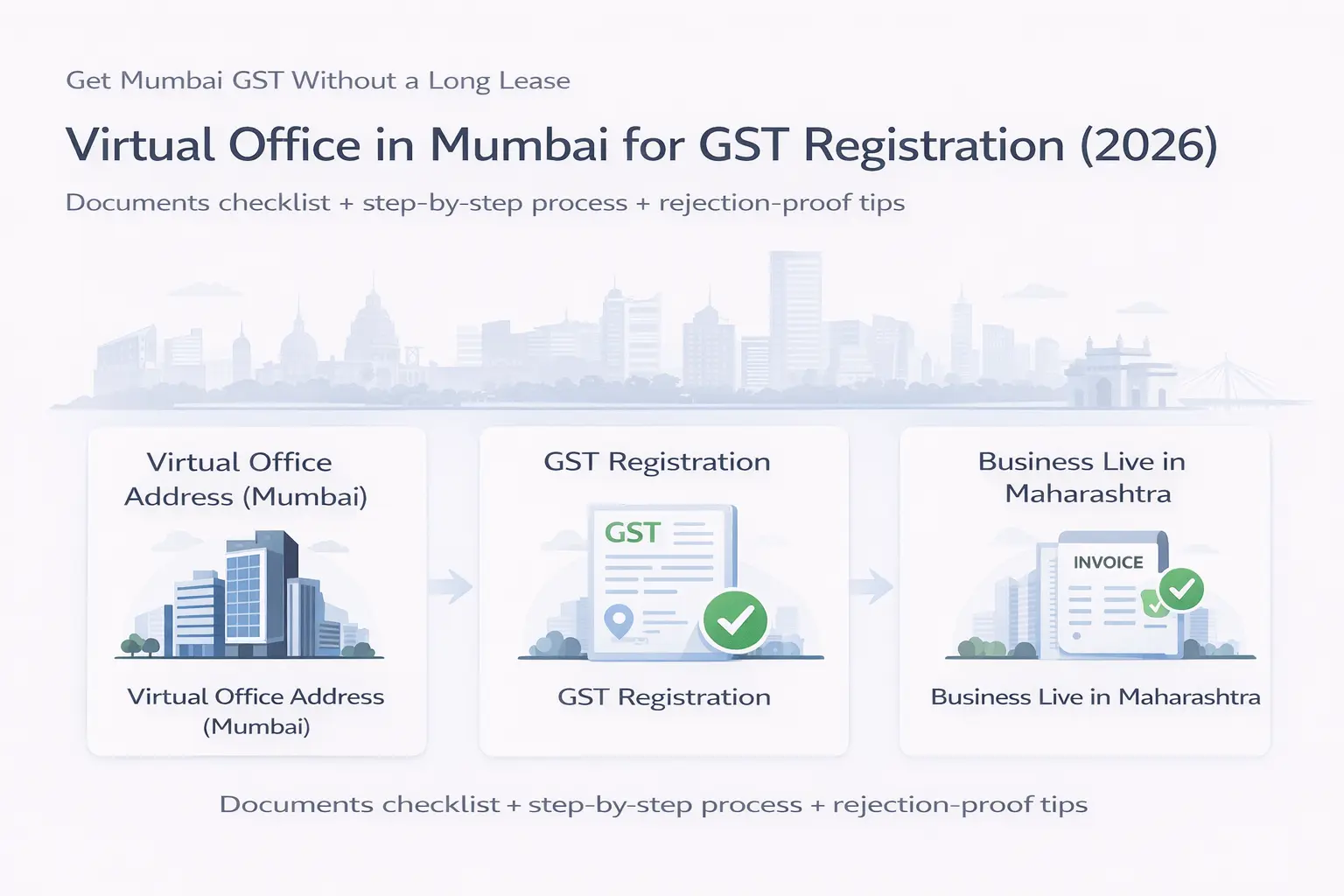
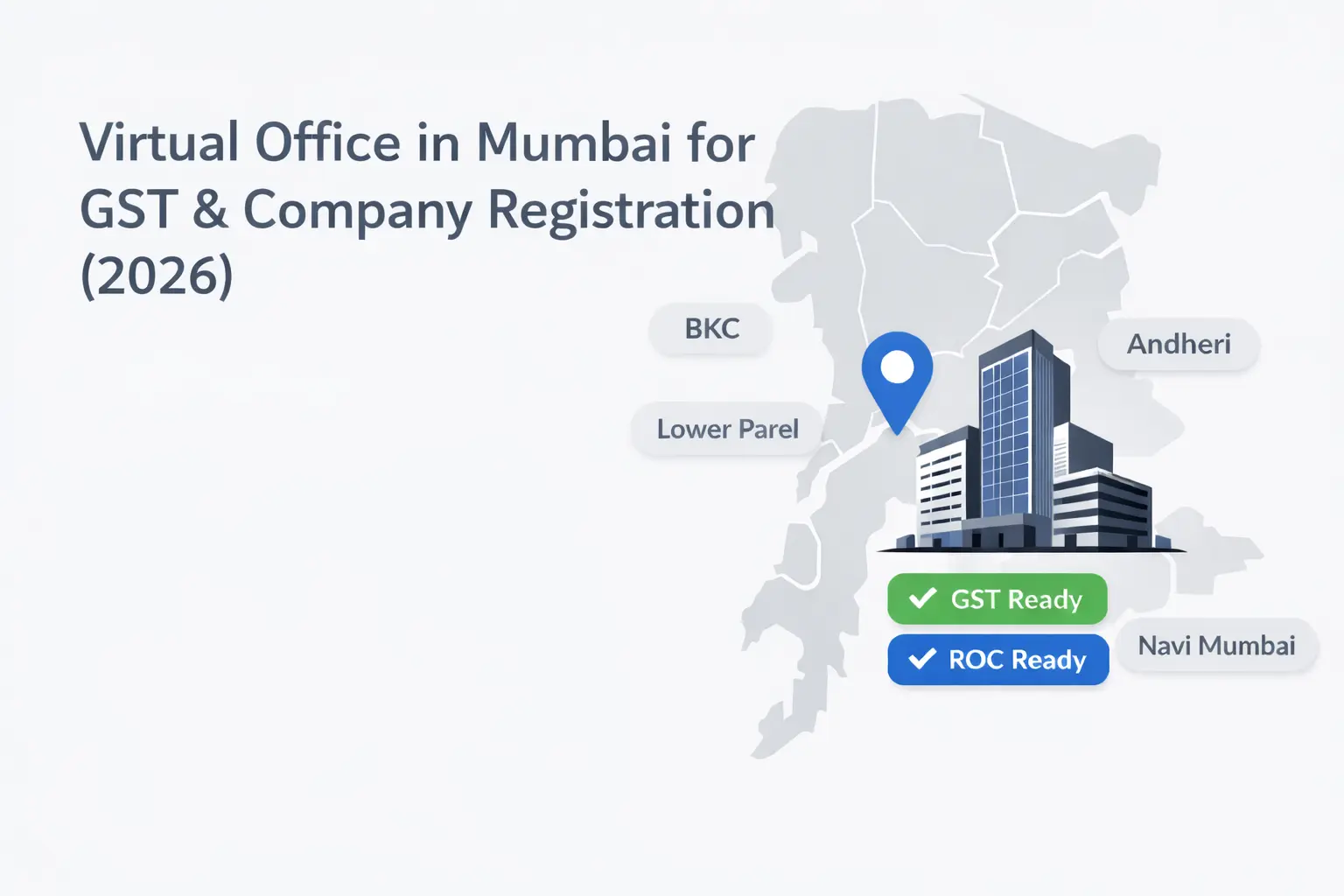
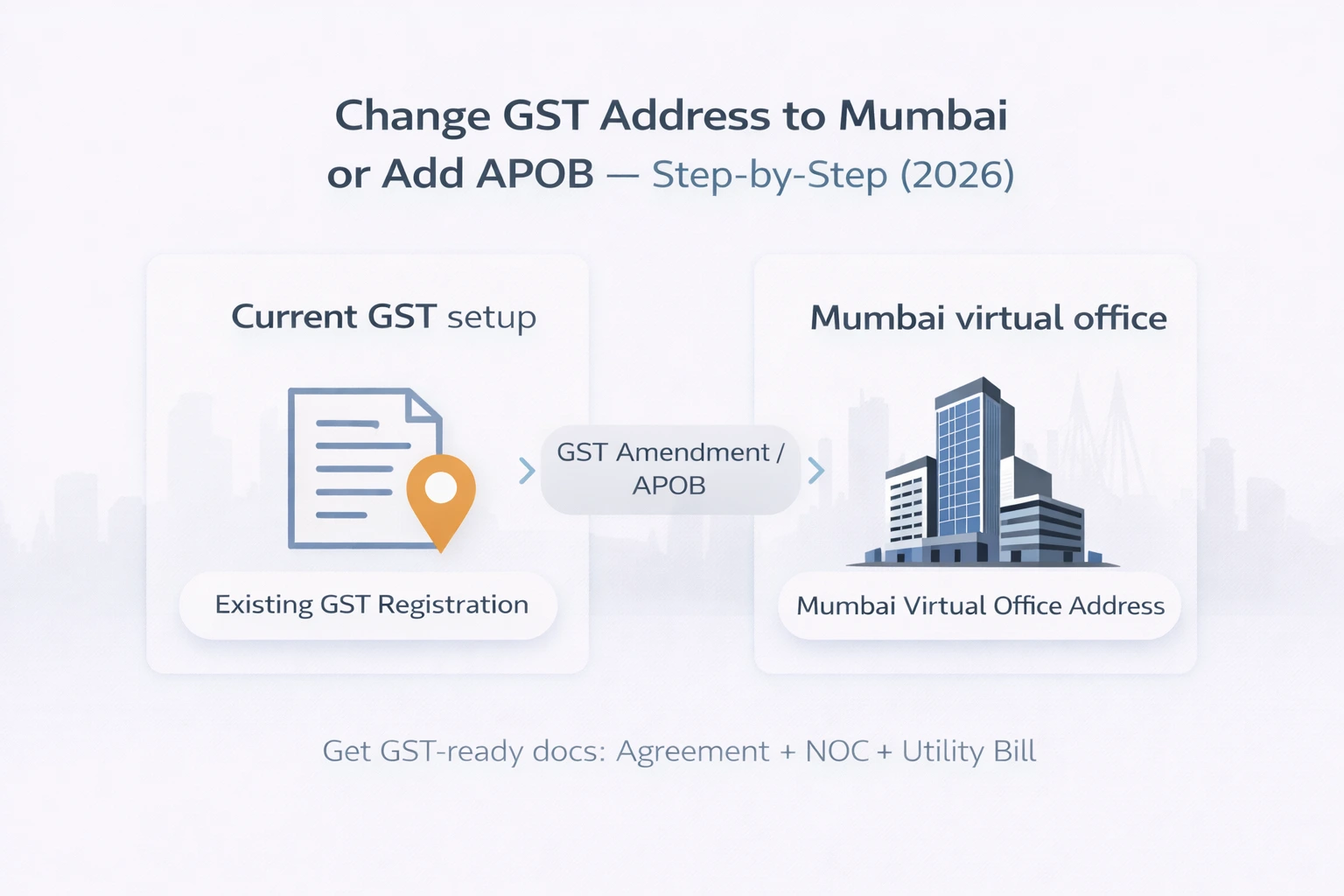
If you’re looking at GST, you’re past the “should I?” stage.
You already know your business needs GST registration in Mumbai / Maharashtra. Maybe your clients or partners are here. Maybe your CA has told you that a Maharashtra GST is the next logical step. Now you’re trying to solve a more specific puzzle:
“Can I use a virtual office in Mumbai for GST registration – and if yes, what’s the exact process?”
You’re not the only one asking.
For a lot of founders and teams, a full-time office in BKC, Nariman Point, Lower Parel, Andheri, Powai or Navi Mumbai feels like using a sledgehammer to push in a drawing pin. You want the compliance and credibility of a Mumbai address, but you don’t want to commit to a long, expensive lease just to get your GST done.
That’s exactly where a virtual office in Mumbai for GST registration fits in.
In this guide, we’ll walk through:
-
When a Mumbai virtual office is (and isn’t) a good fit for GST
-
The exact documents you need – from your provider and your business
-
A step-by-step GST registration process using a virtual office address in Mumbai
-
Common pitfalls and how to avoid them
-
What happens after approval and how to actually use your Mumbai GST
-
FAQs specific to “virtual office in Mumbai for GST registration”
If you already have GST elsewhere and want to change your GST address to Mumbai or add Mumbai as an Additional Place of Business (APOB), that’s an amendment/APOB use case. This article focuses on getting GST registration in Mumbai using a virtual office as your place of business.
Before You Start – Is a Mumbai Virtual Office the Right Fit for Your GST Use Case?
Before you dive into the GST portal or call your CA, it’s worth checking if a virtual office in Mumbai really matches your situation.
Where a Mumbai virtual office works really well for GST
A virtual office in Mumbai for GST registration is usually a great fit when:
-
You’re registering a new business with a Mumbai presence.
You want your GST certificate to clearly say “Mumbai, Maharashtra”, but your team is remote or small and doesn’t need a big office yet. -
You already have a business in another state and now need Maharashtra GST.
Maybe you’re based in Delhi, Bangalore, or another city, but more of your clients, vendors or partners are in Mumbai. You want a Mumbai GST number without overextending on built-out space. -
You’re an e-commerce or D2C brand.
Your CA or platform recommends Maharashtra GST for logistics, warehousing, or customer distribution reasons. A Mumbai virtual office gives you a clean, high-signal address for your GST registration. -
You run a services, consulting, media, fintech or tech business.
Your work is digital or hybrid. You meet clients occasionally, but you don’t need a large dedicated office. You do need a proper Mumbai place of business for GST.
In all these cases, the “place of business” is more about compliance, mail and presence than about seating your full team daily.
Situations where you should double-check with your CA
You should have a more detailed chat with your CA first if:
-
Your business involves factories, manufacturing or warehouses where you must clearly show an operational premises.
-
You’re going for licences that explicitly expect a full, operational site as the main place of business.
-
You already have a complex multi-state GST structure and Mumbai is one more moving part.
In those cases, a virtual office in Mumbai can still be useful – for example, as a head office or correspondence address – but your CA should confirm what is acceptable as a GST “place of business” in your specific situation.
Quick recap – how virtual offices plug into GST (in plain language)
For GST, authorities care about:
-
The address you declare as your place of business
-
Your legal right to use that address
-
Proof of that right (agreements, NOCs, premises proof)
-
Whether they can send notices or visit that premises if needed
A virtual office in Mumbai is simply:
-
A real commercial premises run by a business centre or coworking operator
-
Where you have the right to use their address
-
And you get a structured documentation pack to prove that right
Once that documentation is solid, the GST registration process with a virtual office looks very similar to a traditional rented office – just without the big rent and fit-out.
Documents Required for GST Registration in Mumbai with a Virtual Office
GST registration with a virtual office in Mumbai is 50% documents and 50% process. If the documents are messy, the process becomes messy.
You’ll need documents from:
-
Your Mumbai virtual office provider
-
Your business and authorised signatory
1. Documents from your Mumbai virtual office provider
If your virtual office plan is genuinely GST-ready, your provider should give you:
-
Service / Rent / Licence Agreement
-
Between your business and the provider
-
Clearly mentions the full Mumbai address to be used for GST
-
No Objection Certificate (NOC)
-
From the premises owner or operating company
-
States that they have no objection to you using the premises as a place of business
-
Recent premises proof
-
Typically an electricity bill, water bill, or property tax receipt
-
Address on this proof must match your agreement
Providers like Xporate design their Mumbai virtual office plans so this “GST documentation pack” is standard and suitable for Maharashtra GST applications – not just for a nameplate.
2. Documents from your business (entity + promoters)
Your CA will give you an exact checklist, but broadly, you’ll need:
For a proprietorship:
-
PAN of proprietor
-
Aadhaar and photograph of proprietor
-
Bank proof (cancelled cheque, bank statement, or passbook)
-
Email ID and mobile number for GST OTPs
-
Any additional KYC documents as per the portal
For a company or LLP:
-
PAN of the company/LLP
-
Incorporation certificate
-
MoA & AoA or LLP Agreement
-
PAN, Aadhaar and photographs of directors/partners and authorised signatory
-
Board resolution / authorisation letter for the authorised signatory
-
Bank proof (statement, cancelled cheque or passbook)
Your CA will also collect details like:
-
Nature of business
-
HSN/SAC codes
-
Contact details for the GST registration
3. Mumbai-specific best practices that reduce friction
Not mandatory, but very helpful:
-
A single “master address line”:
-
Copy the Mumbai address exactly from your agreement and use that version everywhere – on the GST portal, in documentation, and in internal records.
-
Clean, readable scans:
-
No half-cut pages, shadows or blurry images.
-
PDFs are easier to handle and re-use.
-
A quick pre-check between your CA and provider:
-
Let your CA quickly review the agreement, NOC and premises proof before you file.
Fix small issues upfront instead of waiting for a GST query.
📌 Mumbai GST Registration – Quick Checklist
You can style this as a highlight box in the page:
-
✔ Mumbai virtual office agreement
-
✔ NOC for the Mumbai premises
-
✔ Recent premises proof (utility bill / property proof)
-
✔ PAN & KYC of authorised signatory
-
✔ Incorporation documents (if applicable)
-
✔ Bank proof (statement / cheque / passbook)
-
✔ Email & mobile number for GST OTPs
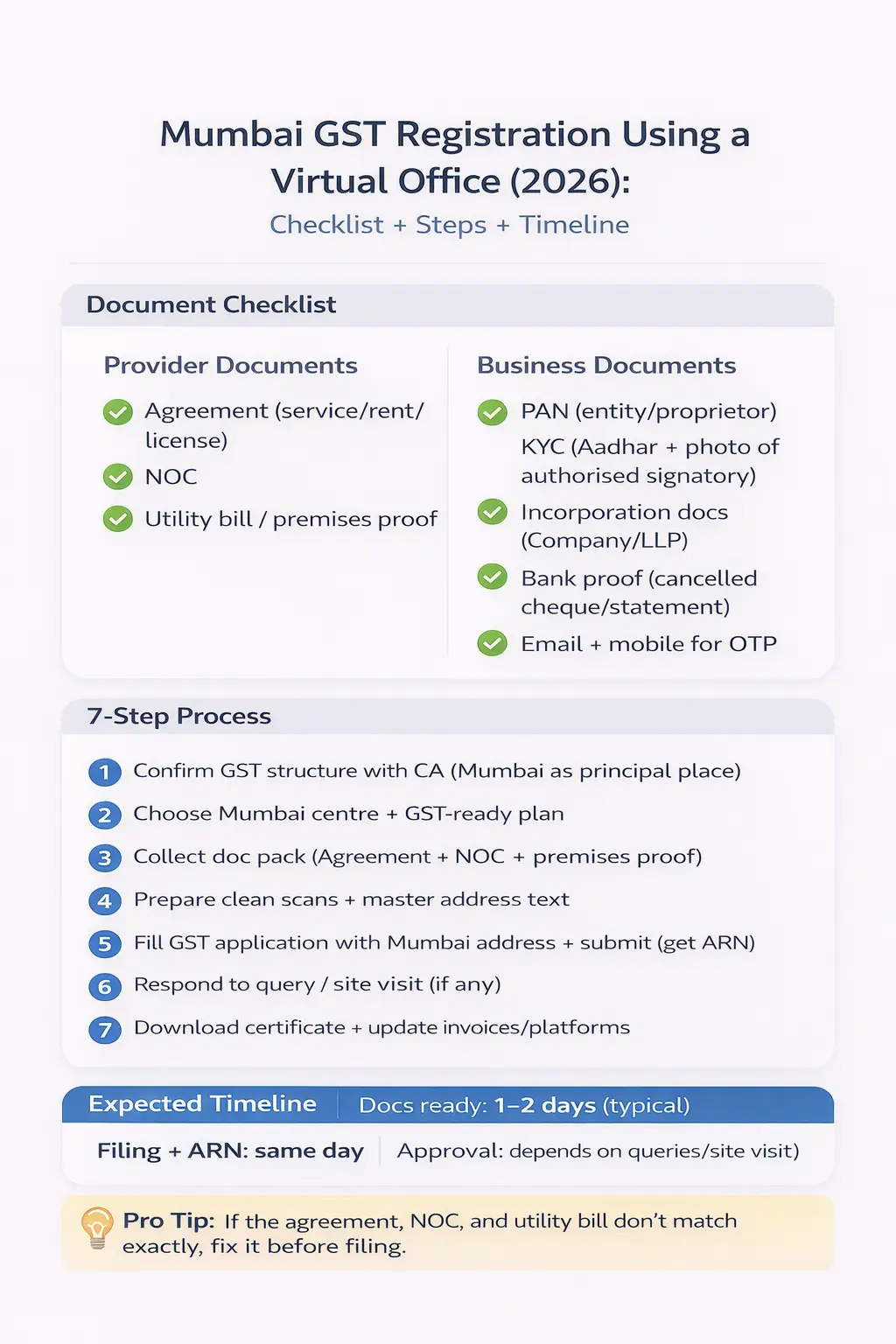
Step-by-Step: GST Registration in Mumbai Using a Virtual Office Address
Now let’s walk through the process. We won’t mirror every single field on the GST portal (it changes), but the sequence and logic below will stay useful.
Step 1 – Decide where Mumbai fits into your GST structure
First, talk to your CA about how Mumbai sits in your GST footprint:
-
Will Mumbai be your principal place of business in Maharashtra?
-
Or will it be an Additional Place of Business (APOB) under an existing GST?
Common patterns:
-
New business in Mumbai → Mumbai often becomes the principal place.
-
Existing business in another state adding Maharashtra GST via Mumbai → Mumbai is often a place of business under a new Maharashtra GST or an APOB if you already have a Maharashtra registration.
This choice affects how your CA sets up the application. Decide it before you start.
Step 2 – Set up your Mumbai virtual office and get the documentation pack
Before you even touch the GST portal, you should:
-
Choose a Mumbai locality and centre that fits your brand and budget
-
Could be BKC, Andheri, Powai, Lower Parel, Navi Mumbai, etc., depending on actual Xporate centres.
Select a GST-ready virtual office plan
-
Make sure the provider explicitly says the plan is suitable for GST registration (and ROC if you need that too).
Complete KYC and onboarding with the provider
-
Share your entity details, KYC of the authorised signatory, and your intended use (principal place vs APOB, etc.).
Receive your Mumbai documentation pack
-
Agreement, NOC, and premises proof.
Your CA will use this pack as proof of your place of business in Mumbai.
Step 3 – Prepare clean digital copies of all documents
Good prep here saves you a lot of headaches later:
-
Scan all documents in good resolution, with full pages visible.
-
Name files meaningfully (e.g. Mumbai-Agreement.pdf, Mumbai-NOC.pdf, Mumbai-UtilityBill.pdf).
-
Paste your master Mumbai address into a text file or doc and use that for all address fields.
Most annoying GST queries are caused by sloppy scans and minor address mismatches, not by big legal issues.
Step 4 – Fill the GST application with your Mumbai virtual office address
On the GST portal (usually handled by your CA):
-
For new GST registration in Maharashtra:
-
Your Mumbai virtual office address will be entered as the place of business.
-
Your CA will choose the correct nature of premises (business centre, rented, etc.).
-
For adding Mumbai as a new place of business under an existing Maharashtra GST:
-
The Mumbai virtual office address is added under “Place of Business” as principal or APOB depending on the plan.
Your job:
-
Check that the address being entered matches your documentation exactly.
-
Confirm that the entity name, PAN and other details are correct.
Step 5 – Upload documents and submit your application
Your CA will then:
-
Upload the Mumbai agreement as proof of right to use the premises
-
Upload the NOC
-
Upload the utility bill or premises proof
-
Upload your entity and KYC documents
Once all documents are uploaded:
-
The application is submitted
-
You receive an ARN (Application Reference Number)
-
You or your CA can track the status of your Mumbai GST registration
Step 6 – Respond to department queries or site visits in Mumbai
After submission, one of three things usually happens:
-
The application is approved without queries
-
The officer raises a query (asking for clarifications or better documentation)
-
A site visit is scheduled to your Mumbai address
If there’s a query:
-
Read it carefully with your CA.
-
If it’s about documentation quality, ask your provider for clearer or updated documents.
-
Sometimes a short, clear explanation of the business centre / virtual office model helps.
If there’s a site visit:
-
Your provider should ensure the front-desk team knows your company name and that you’re a virtual office client.
-
The staff should be able to confirm:
-
The address is a business centre
-
Your company is associated with that centre as a virtual office client
Xporate centres, for example, are generally set up with internal processes for dealing with GST/department visits for virtual office clients.
Step 7 – After approval: confirm and start using your Mumbai GST registration
Once your application is approved:
-
Download your GST registration certificate
-
Verify that:
-
The Mumbai address is correct
-
Your entity name and details are accurate
Update:
-
Your invoice formats and accounting/ERP tools
-
Marketplaces, payment gateways and platforms where GST details are required
-
Internal documentation and SOPs
From this point on, you’re live with Maharashtra GST using a Mumbai virtual office address.
Need a GST-ready virtual office address in Mumbai?
Share your use case once and we’ll recommend centres, plan types and documentation options that fit your GST timeline.
Get Mumbai GST virtual office options
Common GST Pitfalls with Mumbai Virtual Offices (and How to Avoid Them)
Even with a good plan and provider, some mistakes happen again and again.
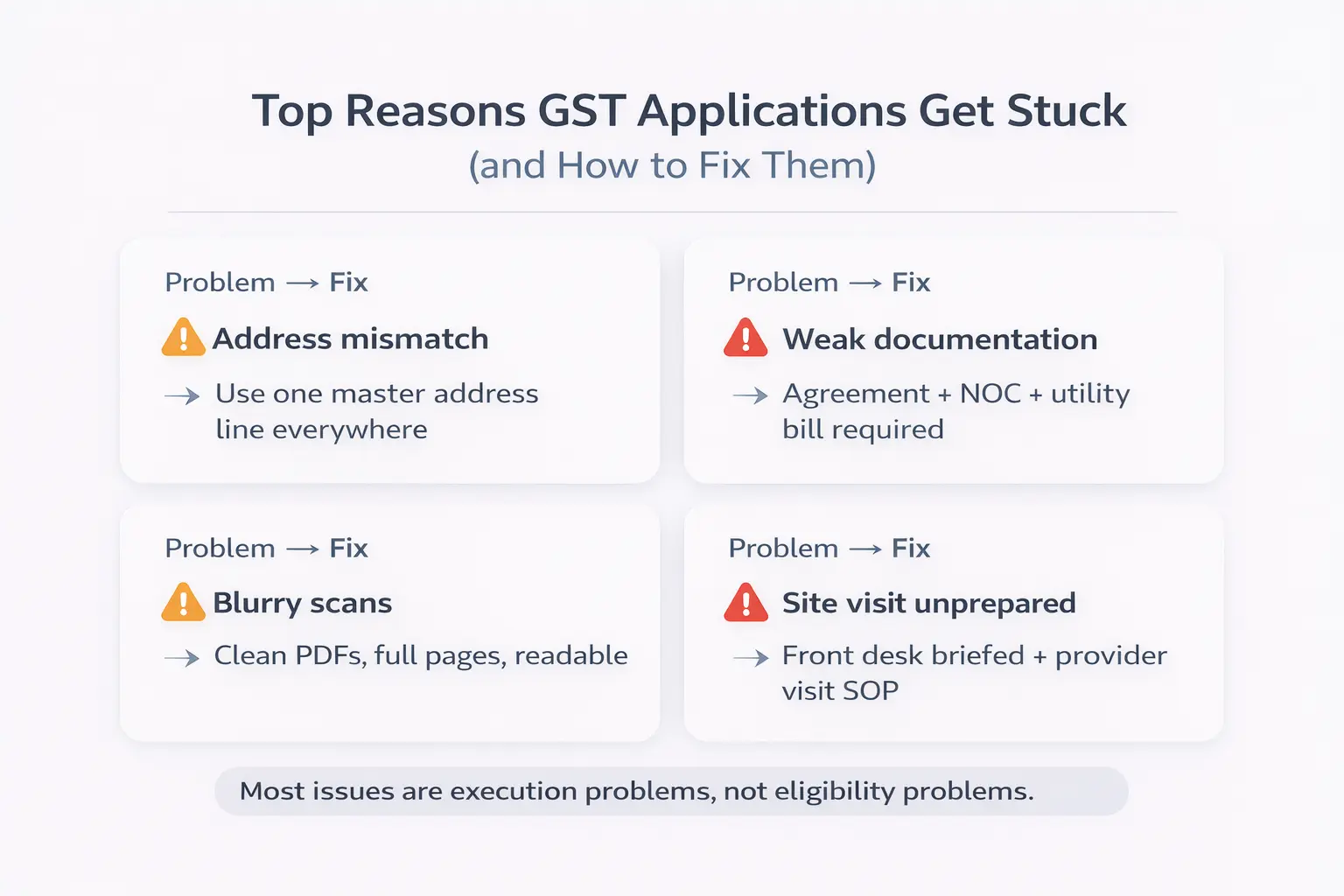
Pitfall 1 – Address mismatches across documents and the GST portal
Typical pattern:
-
Agreement has one version of the address
-
Utility bill has another
-
GST form has a third spelling or missing parts
This makes officers nervous because it looks inconsistent.
How to avoid it:
-
Create a master address line directly from your agreement.
-
Use copy-paste for the address in the GST form instead of retyping.
-
If provider docs have inconsistencies, ask for corrected documents before you file.
Pitfall 2 – Weak or incomplete documentation from informal providers
Some founders try to cut corners with:
-
A friend’s flat or house address
-
A provider that offers nothing more than a “nameboard” and vague promise
-
No clear NOC or premises proof
This can lead to queries, rejections, or problems later.
How to avoid it:
-
Choose a provider whose Mumbai plans are explicitly “GST-ready”, not just “address” plans.
-
Confirm you’ll receive:
-
A proper agreement
-
A clear NOC
-
A recent premises proof
-
Ask to see a sample documentation set (with sensitive details blocked) if you’re unsure.
Pitfall 3 – Incomplete KYC or messy entity paperwork
Even with a perfect address, GST applications get stuck because:
-
PAN/Aadhaar copies are unclear or out of date
-
Bank proof is missing or incomplete
-
Board resolution or authorisation is not prepared correctly
How to avoid it:
-
Let your CA maintain a simple KYC checklist for the entity and authorised signatory.
-
Store updated scans in a shared, secure folder so you’re not scrambling last minute.
Pitfall 4 – Assuming “virtual office means no site visit ever”
Having a virtual office doesn’t magically eliminate the possibility of visits.
How to avoid it:
-
Confirm with your provider how they handle officer visits at the Mumbai centre.
-
Make sure your company name is known at the front desk as a virtual office client.
-
Follow any signage/directory guidelines they share.
Using Your Mumbai GST Registration in Day-to-Day Business
Once the certificate arrives, your Mumbai GST shouldn’t just sit in a folder.
Updating invoices, platforms and contracts
After GST approval with your Mumbai virtual office address:
-
Update all invoice templates with the correct GSTIN and address
-
Ensure your accounting or ERP software uses the Mumbai details correctly
-
Update marketplaces, payment gateways and platforms that store GST info
-
Update standard contracts and proposals where your place of business is mentioned
Consistency prevents headaches later.
How mail, notices and couriers are handled at your virtual office
With a Mumbai virtual office plan:
-
The centre receives mail, notices and parcels on your behalf
-
There’s a defined process for notifying you (email, calls, portal, WhatsApp — depending on provider)
-
You can usually choose between:
-
Picking up documents yourself
-
Having them scanned and emailed
-
Having them forwarded to another address
When you sign up, clarify:
-
How frequently they check mail
-
How quickly they notify you
-
What happens if an urgent GST notice arrives
Extending from Mumbai to a multi-city GST footprint
Once you’ve done GST registration in Mumbai using a virtual office, you have a playbook you can reuse:
-
Add Delhi, Gurgaon, Bangalore, Hyderabad, etc. with similar virtual office setups.
-
Each new city follows a familiar pattern: pick provider → get documentation → file through your CA.
For high-growth businesses, this becomes the backbone of a multi-city presence without multi-city office rent.
FAQs – GST Registration in Mumbai with a Virtual Office
1. Is a virtual office in Mumbai accepted as a place of business for GST?
Yes. A virtual office address in Mumbai can be used as your place of business for GST as long as it is a genuine commercial premises and you have proper documentation (agreement, NOC and premises proof). GST authorities care about the legitimacy and consistency of your place of business, not the label “virtual” vs “traditional.”
2. Are there any special rules in Maharashtra for using a virtual office for GST?
Maharashtra follows the same national GST law as other states. There isn’t a separate “virtual office” rulebook. In practice, officers may look more carefully at shared / business-centre addresses, so having a strong documentation pack and a provider who understands how GST verification works is important.
3. What documents should my Mumbai virtual office provider give for GST registration?
Your provider should typically give you:
-
A service / rent / licence agreement for the Mumbai premises
-
A No Objection Certificate (NOC) from the owner or operator
-
A recent utility bill or premises proof for the same address
These documents show you have a legitimate right to use the Mumbai premises as your place of business.
4. How long does GST registration take in Mumbai with a virtual office address?
Once your documents are ready and your CA has filed the application, the timeline depends on:
-
Officer workload
-
Whether any queries are raised
-
Whether a site visit is scheduled
With clean documentation and quick responses, many registrations complete within a few weeks, but the exact timeline is controlled entirely by the department.
5. Will a GST officer visit my Mumbai virtual office address?
A visit is possible. Officers may visit to confirm:
-
The address exists and is a commercial premises
-
The business centre recognises your company as a client
-
Your declared nature of business matches what they see
This is why it’s important to work with a provider whose centres and front-desk teams are prepared to handle verification visits for virtual office clients.
6. Can I use the same Mumbai virtual office address for both GST and company registration?
Yes. Many companies use the same Mumbai virtual office address as their registered office for ROC and as their place of business for GST. You just need to choose a plan that explicitly supports both, and keep your documentation and filings consistent across MCA and GST.
7. Can I add Mumbai as an Additional Place of Business (APOB) using a virtual office address?
Yes. If you already have GST and want to add Mumbai as an APOB, your CA can file an addition using the documentation pack from your Mumbai virtual office provider. The process is similar to a new place-of-business registration but structured as an amendment.
8. What happens if my GST application is rejected when using a Mumbai virtual office address?
Most rejections are due to practical issues like:
-
Address mismatches
-
Poor-quality scans
-
Missing documents or unclear explanations
Review the rejection note with your CA and your provider, fix the exact points raised, and reapply with clearer documentation and, if needed, a short explanation of the business-centre model.
9. Can I later move my GST address from a Mumbai virtual office to a physical office?
Yes. As your business grows and you move into a physical office in Mumbai or another city, your CA can file a core field amendment to change your place of business. A virtual office is often the best way to start quickly and compliantly, not a forever lock-in.