


If you’re here, you’re not wondering whether GST exists. You already have a GST registration.
Your real question is more specific:
“How do I move my GST address to Delhi, or add Delhi as an additional place of business, without renting a full office?”
That’s where a virtual office in Delhi comes in. If your business has evolved, moved online, or expanded into new markets, using a Delhi virtual office as your GST address (or as an Additional Place of Business, APOB) can be a very efficient move.
In this guide, we’ll walk through:
-
Whether you should change your principal place of business to Delhi or just add Delhi as APOB
-
The documents you need from your business and from your Delhi virtual office provider
-
Step-by-step flows for:
-
Changing your principal GST address to a Delhi virtual office
-
Adding Delhi as an APOB using a virtual office address
-
Common pitfalls and how to avoid unnecessary queries or rejections
-
How this looks in practice with a provider like Xporate, which offers GST-ready virtual offices in multiple Delhi locations
Think of this as the guide you send to your CA, co-founder or finance lead when everyone is saying: “Let’s shift/add Delhi, but what exactly do we have to do?”
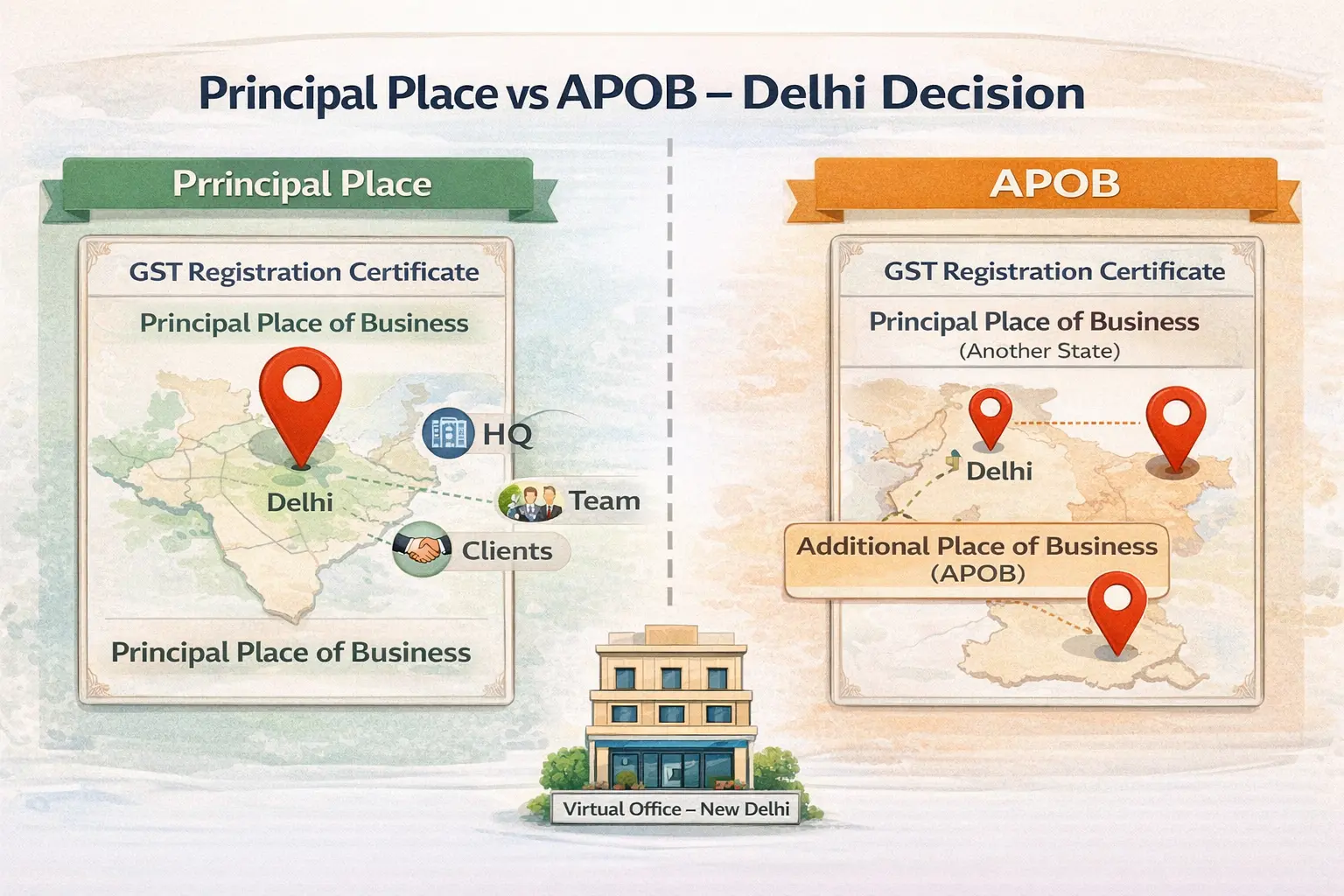
Address Change vs APOB – What Makes Sense for Delhi?
Before touching the GST portal, you and your CA need to decide one big thing:
Should Delhi be your main GST address, or just an additional one?
When to change your principal place of business to Delhi
Changing your principal place of business to Delhi can make sense when:
-
Your company’s centre of gravity has moved to Delhi or NCR.
-
Your core customers, team, or leadership are all essentially Delhi-based now.
-
You want your primary GST registration to reflect Delhi for brand or operational reasons.
In that case, you’ll be filing an amendment on the GST portal to shift the principal address to a Delhi virtual office (or physical office, if you have one).
When to keep your current principal place and add Delhi as APOB
Adding Delhi as an Additional Place of Business (APOB) is usually smarter if:
-
Your main operations, warehouse, or HQ remain in another state or city.
-
You just want to sell into Delhi, service Delhi clients, or use Delhi for specific business lines.
-
You need a Delhi address for invoices, documents, or a local presence, but it’s not the heart of your business.
In that case, you keep your existing principal GST address and add a Delhi virtual office as APOB.
How a Delhi virtual office fits into both options
The nice thing about a Delhi virtual office is that it can support either route:
-
It can become your principal place, if Delhi is effectively your HQ.
-
Or it can be your APOB, if Delhi is an additional market.
The underlying requirement in both scenarios is the same:
you need a legitimate commercial address in Delhi and a complete documentation pack from your virtual office provider.
If you’re still deciding whether a virtual office in Delhi is right for you, read our full overview of Delhi virtual offices for GST and company registration.
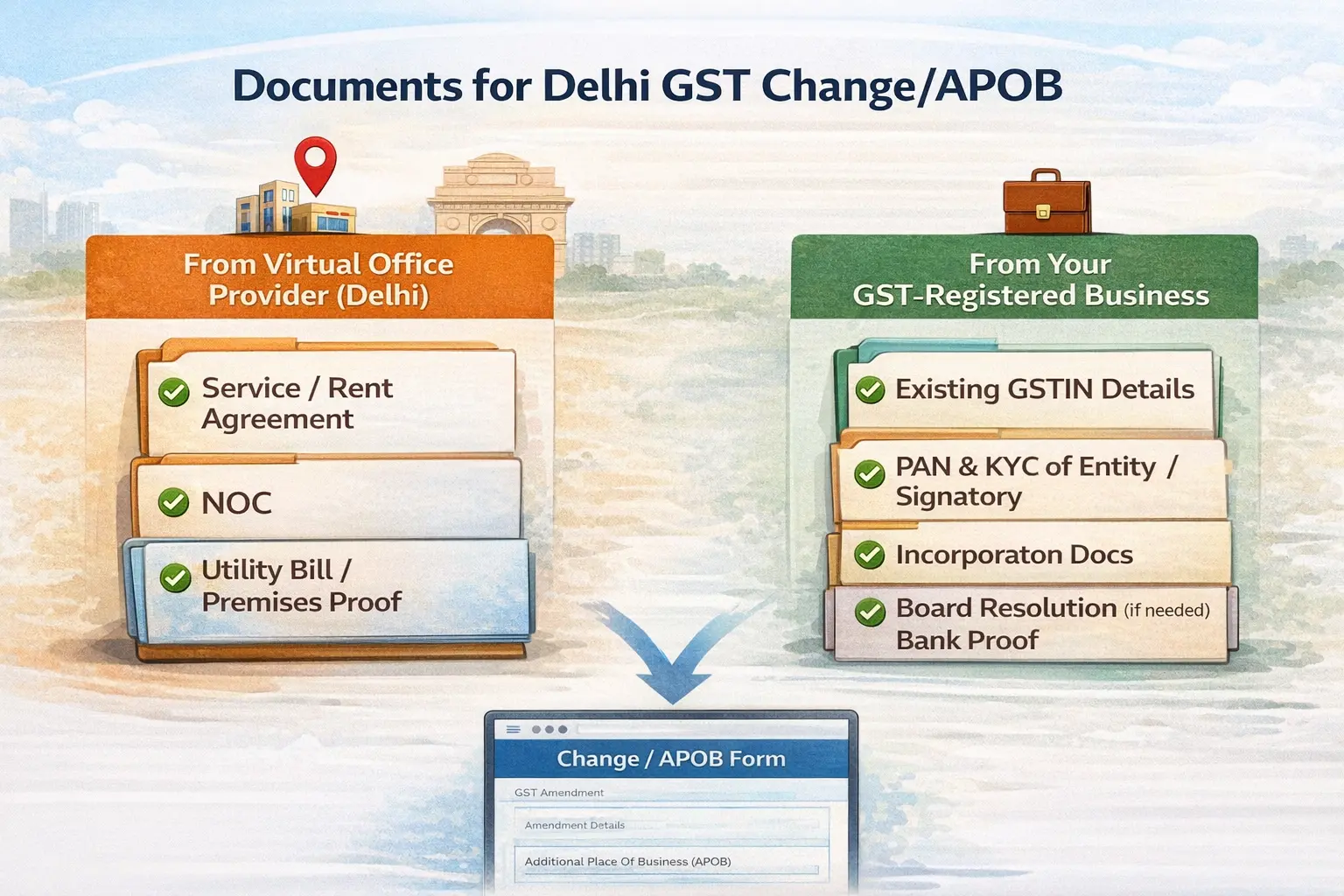
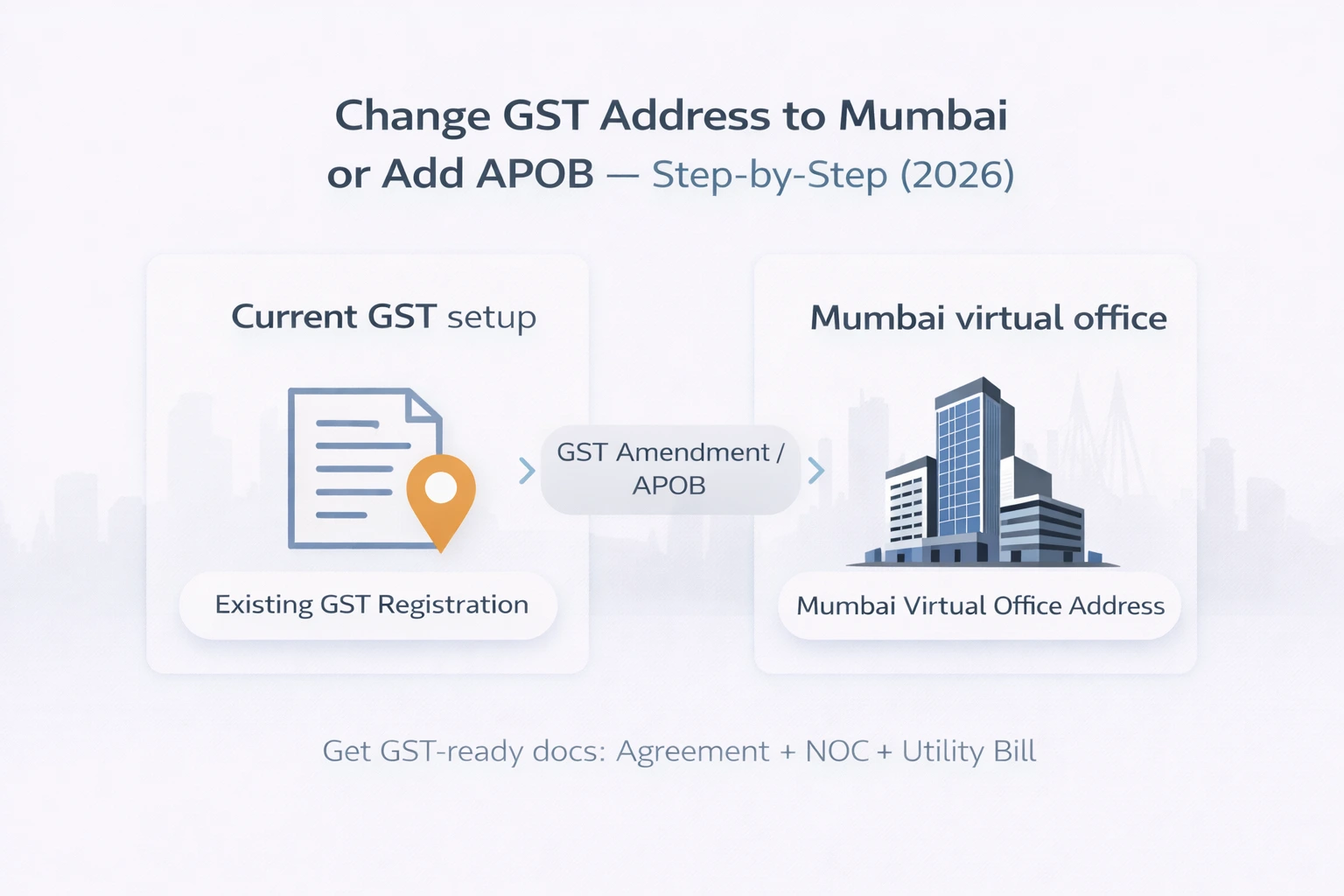
Documents You Need to Change or Add a Delhi GST Address Using a Virtual Office
Whether you’re changing your principal place or adding an APOB, you’ll be dealing with two sets of documents:
-
From your Delhi virtual office provider
-
From your existing GST-registered business
1. Documents from your Delhi virtual office provider
For GST address change or APOB in Delhi, you’ll typically need:
-
Service / Rent / Licence Agreement
-
Between your business and the virtual office provider
-
Clearly shows the full Delhi address of the premises
-
No Objection Certificate (NOC)
-
From the owner or authorised entity
-
Confirms they have no objection to your business using the premises as a place of business
-
Recent Premises Proof
-
Commonly an electricity bill, water bill, or property tax receipt
-
Should match the address on the agreement and NOC
Providers like Xporate structure their Delhi virtual office plans to include this entire pack as standard for GST and ROC use, not just as a “nice-to-have” extra.
2. Documents from your existing GST-registered business
Because you already have GST, your base documents are mostly ready, but your CA may pull from:
-
Current GSTIN details
-
PAN of the entity / proprietor
-
Incorporation documents (Certificate, MoA/AoA / LLP Agreement, etc.)
-
KYC of authorised signatory (PAN, Aadhaar, photo)
-
Board resolution / authorisation letter (for companies/LLPs)
-
Bank proof (statement, cancelled cheque, or passbook)
If you’re adding Delhi as APOB, think of it as updating your GST story, not rewriting it.
3. Principal vs APOB – mini checklist
You can style this as a table or two side-by-side boxes in the blog:
For changing principal place to Delhi
-
✔ Agreement (Delhi virtual office)
-
✔ NOC (Delhi premises)
-
✔ Delhi utility bill / premises proof
-
✔ Existing GSTIN details
-
✔ Entity and promoter KYC
-
✔ Board resolution/authorisation (if required)
For adding Delhi as APOB
-
✔ Agreement (Delhi virtual office)
-
✔ NOC (Delhi premises)
-
✔ Delhi utility bill / premises proof
-
✔ Existing GSTIN & current place details
-
✔ Entity and promoter KYC (for verification, if needed)
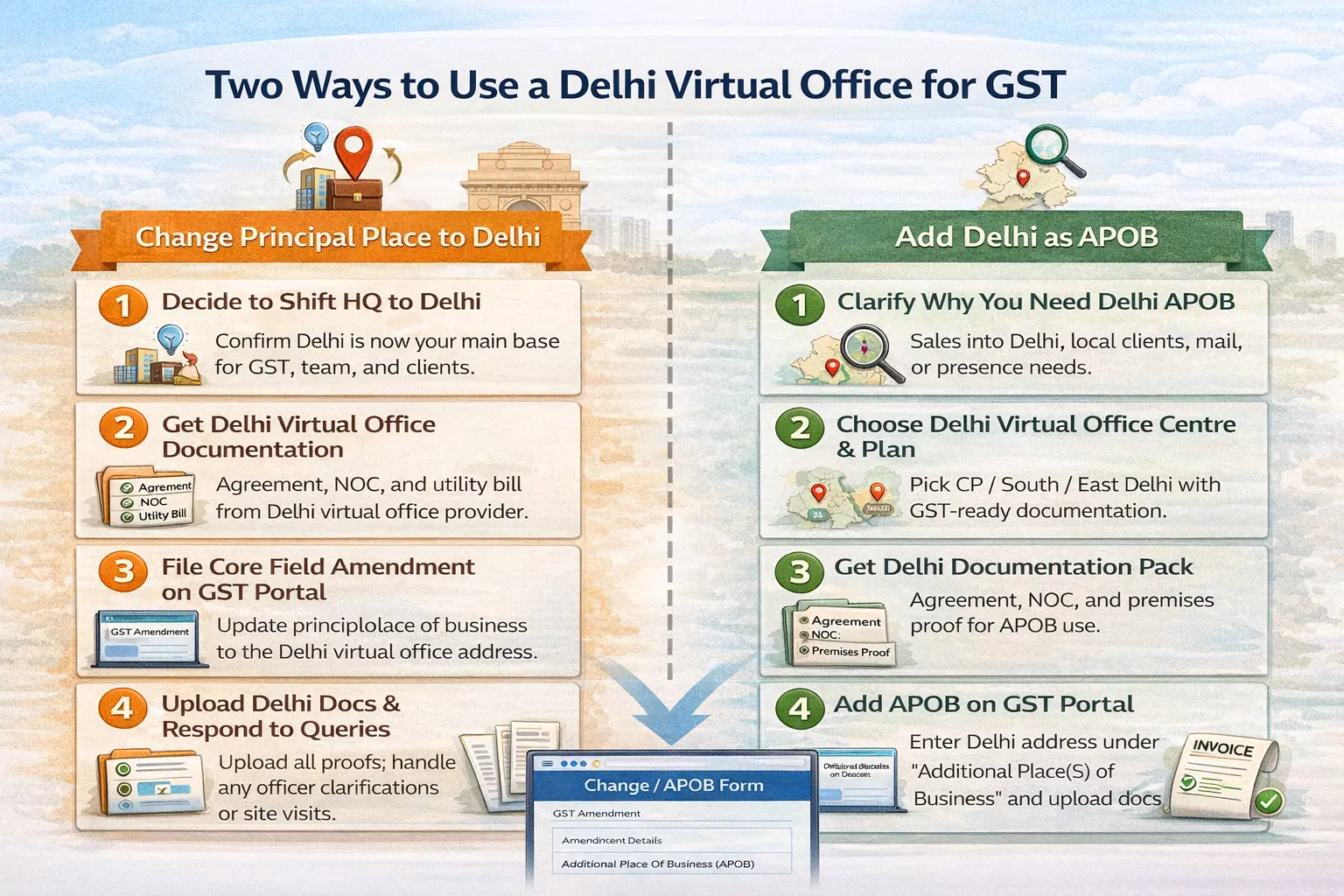
Step-by-Step: Changing Your Principal GST Address to a Virtual Office in Delhi
Let’s start with the heavier scenario: moving your principal place of business to Delhi.
Step 1 – Confirm with your CA that Delhi should be your principal place
This isn’t just a cosmetic choice:
-
Your state code for GST will align with your principal place.
-
Your compliance narrative (where you operate from) needs to match reality.
If your operations, team, and clients are mainly in Delhi/NCR now, changing the principal place to Delhi can be logical. Your CA will advise based on your specific structure.
Step 2 – Get your Delhi virtual office documentation pack in order
Before filing any amendment:
-
Choose a Delhi centre and plan with your virtual office provider (e.g., business address + GST support).
-
Complete their KYC and onboarding.
-
Collect the agreement, NOC, and premises proof in digital format.
With Xporate, for example, you’d pick a Delhi location, complete KYC, and receive a GST-ready documentation pack you can immediately share with your CA.
Step 3 – Initiate address change on the GST portal
Your CA or GST consultant will:
-
Log into the GST portal with your existing GSTIN.
-
Choose the appropriate core field amendment (for principal place of business).
-
Enter the new Delhi address from your agreement, exactly as written.
Details like floor number, building name, locality and PIN should be copy-pasted, not retyped from memory.
Step 4 – Upload new Delhi virtual office documents
In the amendment form, they’ll upload:
-
The Delhi virtual office agreement (as proof of right to use the premises).
-
The NOC (permission from owner/operating company).
-
The utility bill or property proof for that Delhi address.
-
Any other supporting docs requested by the portal.
They’ll also ensure your existing entity and KYC documents are still valid and correctly attached.
Step 5 – Handle any queries or site visit in Delhi
After submission, a few things can happen:
-
Amendment is processed smoothly and approved.
-
Officer raises a query for clarification or extra documents.
-
Officer may schedule a site visit to the Delhi premises.
If there’s a query:
-
Read it carefully with your CA.
-
If it’s about address clarity or document mismatch, coordinate with your virtual office provider to fix and re-upload.
If there’s a site visit:
-
Make sure the centre’s front desk knows your company name and that you’re a virtual office client.
-
Follow any signage or naming instructions from your provider.
-
Keep soft copies of your agreement and NOC handy.
Step 6 – After approval: reconcile everything with the new Delhi principal address
Once approved:
-
Download your updated GST registration certificate.
-
Confirm that the principal place of business shows the Delhi virtual office address.
-
Update invoices, contracts, and internal systems to reflect the new principal address.
-
Inform any stakeholders (banks, key customers, platforms) if they reference your GST address.
Make Delhi your GST home – without leasing a full office
Share your current GST setup and we’ll help map the right Delhi virtual office plan for a principal place change.
Talk to a Delhi GST advisor
Step-by-Step: Adding Delhi as an Additional Place of Business (APOB) with a Virtual Office
If your current principal place is fine and you just want Delhi as an extra location, the flow is slightly lighter.
Step 1 – Map why you need a Delhi APOB
Clarify your story:
-
Are you selling to Delhi clients from another state?
-
Are you shipping from or through Delhi?
-
Do you need a Delhi address for on-ground operations, meetings, or brand presence?
Your CA will use this to explain and justify the APOB if questions come up.
Step 2 – Choose your Delhi virtual office centre and plan
Pick a Delhi address that:
-
Matches your brand positioning (e.g., central vs budget-friendly).
-
Fits your client and team realities (e.g., Connaught Place, Green Park, Laxmi Nagar, Saket, etc.).
-
Comes with a clear GST-supporting documentation pack.
Xporate, as an example, offers virtual offices across multiple Delhi locations with explicit GST suitability, which makes this step more straightforward.
Step 3 – Get your Delhi documentation pack
Same trio as before:
-
Agreement (Delhi virtual office)
-
NOC (Delhi premises)
-
Utility or premises proof
You’ll use these to prove that your business has the right to use the Delhi address as an additional place.
Step 4 – File APOB addition on the GST portal
On the GST portal, your CA will:
-
Access your existing GSTIN.
-
Go to the section for Additional Place(s) of Business.
-
Add the new Delhi address with all required details.
-
Upload the Delhi virtual office documents in the relevant slots.
Again, address consistency is everything.
Step 5 – Manage queries or inspections focused on the Delhi APOB
Even as an APOB, officers may:
-
Ask for more clarity if shared/virtual addresses are involved.
-
Decide to visit the Delhi premises.
Coordinate with your provider so:
-
Staff at the centre know how to respond if an officer asks about your company name.
-
Any agreed signage or directory listing is in place.
If a query appears in the portal, address it collaboratively with your CA and provider.
Step 6 – Use the Delhi APOB correctly in your operations
Once approved:
-
Update your internal processes – where and when you issue invoices showing the Delhi address.
-
Align any logistics, vendor communication, or contracts that involve Delhi.
-
Use the Delhi virtual office for mail, notices, and meetings related to that APOB.
Common Problems When Changing GST Address to a Delhi Virtual Office
Even with a good plan, a few mistakes show up again and again.
Problem 1 – Old and new addresses getting mixed up
Sometimes documents, applications and communications end up using a mix of:
-
Old address
-
New Delhi address
-
Slightly different spellings of both
How to avoid:
Keep a simple internal note that clearly states:
-
“Old GST address (exact format)”
-
“New Delhi GST address (exact format)”
Use copy-paste from these master lines everywhere.
Problem 2 – Officer doubts about shared/virtual premises
Officers can get cautious when they see multiple businesses at the same address.
How to respond:
-
Make sure your agreement and NOC clearly show your right to use the premises.
-
Explain (or let your CA explain) that this is a business centre / shared office model, not a fake address.
-
Work with providers who are used to handling officer visits and queries.
Problem 3 – Trying to change too many things at once
If you bundle lots of changes (address, legal name, directors, etc.) into one amendment, it can invite extra questions.
How to avoid:
-
Let your CA decide the sequencing.
-
Sometimes it’s cleaner to do the Delhi address change/APOB in a focused amendment instead of combining it with everything else.
How Xporate Supports GST Address Changes and APOB in Delhi
You can do all of this alone, but it’s much easier with a provider that has designed their virtual office product around GST and ROC requirements.
With Xporate, for example:
-
Delhi virtual office plans are built to be MCA/ROC & GST-ready, so agreements, NOCs and premises proofs follow patterns that CAs and officers recognise.
-
The team at each centre knows how to handle virtual office clients’ mail, notices and visits, reducing the risk of confusion during inspections.
-
If and when you’re ready, you can upgrade from a pure virtual office to coworking desks, private cabins or managed offices in the same ecosystem, without rebuilding your entire address identity.
The goal isn’t just to sell you an address; it’s to give your company a clean, credible footprint in Delhi that plays nicely with how GST and ROC actually work in the real world.
FAQs – Changing GST to a Virtual Office Address in Delhi
1. Can I change my GST principal place of business to a virtual office in Delhi?
Yes, as long as the Delhi virtual office is a genuine commercial premises and you have proper documentation (agreement, NOC, premises proof). Your CA will file a core field amendment on the GST portal to move your principal place of business to the new Delhi address.
2. Is using a virtual office okay when adding Delhi as an Additional Place of Business?
Yes. A Delhi virtual office address can be used as an APOB, provided your provider gives you complete documentation and the address is suitable as a place of business. This is common for businesses expanding sales into Delhi without opening a full physical office.
3. How often can I change my GST address?
There’s no fixed “once in a lifetime” limit, but every change has to be justified and documented. Officers may get suspicious if you constantly shift addresses. It’s better to plan your moves strategically and choose stable, long-term premises like a reputable virtual office provider.
4. What if my GST address change to a Delhi virtual office is rejected?
Read the rejection note carefully. Most rejections are due to things like address mismatches, unclear documents or missing information. Work with your CA and virtual office provider to fix the specific issue, then refile with corrected documents and, if needed, a short clarification.
5. Do I have to change my bank and other registrations when I change GST address to Delhi?
You may need to update your address with:
-
Banks
-
Key vendors and platforms
-
Statutory registrations where your place of business is recorded
Your CA or CS can give you a prioritised list so you don’t miss anything important after moving your GST address to Delhi.
6. Can multiple GST registrations use the same virtual office address in Delhi?
Yes, multiple businesses can share the same address at a business centre, as long as each has its own separate agreement and documentation. Authorities focus on whether each arrangement is legitimate and well-documented, not on address exclusivity.
7. Can I keep my old GST address and just add Delhi as APOB with a virtual office?
Yes. If your main operations remain at your current premises, you can keep that as principal place and add the Delhi virtual office as APOB. This is a common pattern for businesses expanding into new cities.
8. What happens if I stop my virtual office plan but don’t update my GST address?
That’s risky. If you no longer legally occupy or have rights over the Delhi premises but your GST registration still shows that address, you’re creating a mismatch. You should always update your GST registration when you change or terminate premises arrangements, whether virtual or physical.
9. Can I downgrade from principal place in Delhi back to another city later?
Yes. You can move your principal place of business again via another amendment. Just be mindful that frequent changes can invite extra scrutiny, and coordinate each move carefully with your CA and office providers.